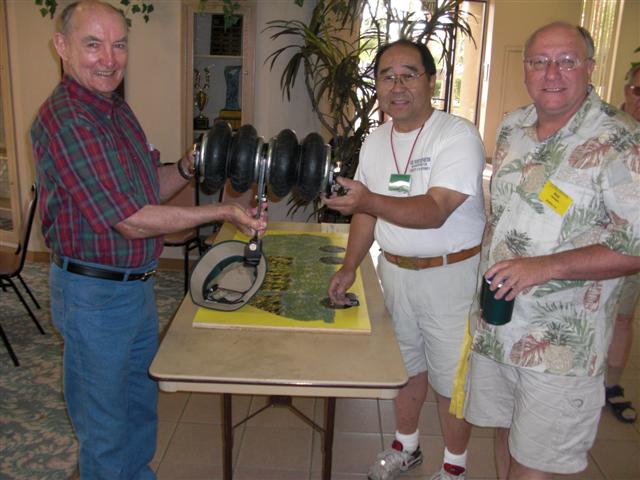
Presented at GMCWS Fall Rally at Bensen, Arizona September 3, 2007.

tn_Chuck Aulger GMC Brakes-02.jpg

0

1

0

0

0

#1. Photo of Jim Kanomata (Applied GMC) 80 mm disc brakes installed on mid axle with ceramic "yellow" pads installed.
#1. Hi Res

#2. Same as # 1 only looking toward rear.
#2. Hi Res

#3. Same as # 1 only looking down.
#3. Hi Res

#4. Same as # 1 except looking forward.
#4. Hi Res

#5. Same as # 1 except looking forward and upward.
#5. Hi Res

#6. Same as # 1 except looking downward.
#6. Hi Res

#7. Same as # 1 except looking aft with sway bar attached.
#7. Hi Res

#8. Similar to # 7.
#8. Hi Res

#9. Looking forward with disc brake caliper removed.
#9. Hi Res

#10. Looking inward with hub and caliper removed.
#10. Hi Res

# 11. Same as # 9 except looking toward rear.
#11. Hi Res

#12. Same as # 9 except brake reaction bar installed.
#12. Hi Res

#13. Same as #12 except different view.
#13. Hi Res

#14. Looking inward with brake caliper and caliper bracket removed
#14. Hi Res

#15. Same as # 14 except looking toward rear.
#15. Hi Res

#16. Chuck Aulgur "rear brake modification" parts off vehicle.
#16. Hi Res

#17. Same as # 16 except looking inward at torque box outward at support.
#17. Hi Res

# 18. Same as # 16 except looking outward at torque box and inward at bearing sup¬port
#18. Hi Res

The Ultimate Rear Brakes Mod for the GMC Motorhome

IMPROVING GMC REAR BRAKING
by Chuck Aulger

Most of us that own GMCs think that the GM engineers did a pretty good job designing our motor homes. That's why we keep driving these 30 plus year old motor homes so we have a good place to stash our extra cash. Besides that, they are still one of the best looking motor home on the roads today. However, that doesn't keep a lot of us from trying various things we think will improve them.

Once we have expended the time and cost to make some of these "improvements", our human nature is to tell everyone how great it works so they will also invest their money the same as you did. That way, we don't feel so bad about the money we may have wasted. The list of modifications that have been made for our GMCs is almost endless and improving the braking capability has been a major item of interest to a lot of us. Who doesn't want better brakes?

With all that said, I will attempt to explain why the brake modifications I have done to the rear brakes on our GMC is the greatest modification ever invented. The swing arm rear suspension GM developed for the GMCs was a big factor in keeping the vehicle low to the ground and providing maximum interior space, along with a very smooth ride. The one major problem with the swing arm suspension is poor braking capability. Apparently, none of the GM engineers that designed the "knee action" used for a very short time on the front suspension on some late 30s cars were still around in the 70s or they weren't assigned to work on the GMC rear suspension. That design had some major problems and a very short life. That design also had a swing arm suspension.

The problem with the GMC rear brakes is when the brakes are applied there is a force vector going from the center of the tire/road contact area to the rotation pin for the swing arm. The angle of this force vector is about 40 degrees from the ground. That results in a little less than 50% of the braking load on the mid axle is pushing up on the suspension arm rotation pin, which is not providing any force to slow the vehicle. This results in only a little more than half of the force generated by the brakes is pushing aft horizontally on the suspension arm pin and is thereby helping to slow the vehicle. Even worse, if the brakes are applied with enough force, the force vector pushing up on the suspension arm will lift the back of the coach to the full travel of the shock absorber limit (fully compressed). This causes more downward force on the mid axle tire, which improved braking capability, but it also unloads the rear tire to the point the rear tires will lock up and slide. You end up with flat spots on the rear tires. If you have good brakes, you cannot make a full pressure panic stop on dry roads with a GMC without sliding the rear tires. When this happens, most all the load on the rear wheels is on the mid axle, which is why it is almost impossible to slide the mid axle tires or the front tires on the GMC motor home. I doubt that anyone has enough braking capability to slide either the mid axle tires or front tires on dry rough concrete pavement. If you don't believe any of this, just stand along the side of a dry rough concrete surface and have someone make a panic stop in your GMC from around 50 mph. With the mid axle raised to its limit, and the front of GMC diving, you most likely will see air space between the rear tire and the pavement.

The braking effect on the rear tires is just opposite of the mid axle, (which makes things even worse). The braking load on the rear tires causes a vertical downward force on the suspension arm rotation pin. It can't put more weight on the rear tires because the downward force is much less then the force pushing upward by the mid axle braking. The net result is the rear brake action unloads the weight on the rear tires to the point where the toque generated by the tire contact with the pavement is equal to the torque generated by the braking action. At the point when the tire slides, there is very little load on the rear tires and a resulting very little load pulling horizontally on the suspension arm rotation pen.

After spending many hours thinking how to solve these problems, I finally concluded the only way was to change the design of the rear braking function to eliminate the torque load that is applied to the suspension arms. To accomplish this, I unbolted the disc brake caliper support from the four bolts that attached it to the suspension arm axle support flange. Doing this eliminates the brakes from applying any torque to the suspension arm axle flange. I used countersunk bolts to attach the axle flange to the end of the suspension arm and I made a brass bearing that allows the caliper support bracket to rotate freely on the axle. I then created what I call a torque box that is bolted to the caliper support bracket that extends inward 4 inches across the top and bottom of the end of the suspension arm. The inboard side of the torque box is enclosed and is supported by another brass bearing that is mounted from the inboard side of the same four bolts that attach the axle to the suspension arm. Thus, the torque box and disc brake caliper bracket become one unit that is free to rotate around the axle and supported by two brass bearings that are lubricated via grease fitting.

The inboard side of the torque box has ears sticking downward that connect through to a spherical rod end. On my mid axle, I connected the rod end to the hole in the end of my sway bar. On the rear axle, the rod end connects through a reaction strut that is connected to a mount bolted to the bottom of the suspension arm support. On the mid axle, the torque generated around the axle from the braking action is reacted back to the vehicle frame thru the sway bar rotation mounts. The rear axle braking torque is reacted thru the reaction strut to the suspension are support, which is bolted to the frame. Thus, when I apply my brakes, the torque load generated by braking is reacted back nearly horizontally to the vehicle frame and does not cause a significant lifting action to the rear of the coach and most all of the braking energy is used to slow the vehicle. Also, the braking torque generated on the rear axles does not cause any lifting action on the rear tires. I can't qualify how much increased braking I have on the rear of the coach but it has to be more then 50%.

This project started about seven years ago when I installed CM (carbon metallic) shoes on my rear brakes, along with 80 mm calipers and CM pads on the front. I ended up with what I thought were very good brakes. The only problem was I had too much braking for the rear suspension and had to be very careful not to apply to much brake pressure, as I could easily slide the rear set of tires. I talked to numerous people about the design mod I had in mind and most of them thought I had been smoking too much pot. Manny was one of the few people that gave me encouragement and he even volunteered to loan me a rear suspension arm and support bracket. The only problem was Manny was so busy with his own projects he kept forgetting to bring it with him on several sojourns to San Diego. Another delay was I could never complete a design. About the time I thought I was through, I would think of a better way to do it and start over. Jim Kanomata was another engineer that was interested in my concept and he keep after me to complete a design and test it. I first completed a model using TSM disc brakes and installed them on the mid axle. Actual brake testing showed the mid axle-lifting problem was totally eliminated. This got Jim so excited he gave a set of his rear 80 mm caliper and disc (plus yellow pads) to install on the other axle and turned up the heat. I moved the TSM 60 mm calipers to the rear wheels and installed his 80 mm caliper set on the mid axle and used my sway bar to react the brake torque, along with its regular job. After installing a new P-30 MC, (that Jim also gave me), and breaking in the new brake pads, I had fantastic brakes. I could then make a full pressure stop without sliding any tires but I did have some problems that were easily corrected. The 5/8" dia threaded spherical ball joints I had used at the sway bar attachment were severely bent backwards and the sway bar mounting brackets were also bent backwards. Reinforcing the sway bar rotation supports and changing to 3/4" dia threaded spherical ball joints solved the problems to date. I'm now ready to show the GMC rally attendees my latest invention and hope you buy many sets from Jim K. Per my agreement with Jim, I will not be putting any photos or engineering drawings on the Internet but videos of the before mod and after mod testing will be available to the public. Jim is having a "real" engineer redesign my concept for production, similar to what he did with the Ken Rose 4-bag mod.

Videos
These are .mov files and will require the free Apple Quicktime viewer available HERE.

#1. Brake test with carbon-metallic 3-inch rear brake shoes. Very low brake pressure required to raise mid axle to full up limit and slide rear tires.

#2. Similar test as # 1 . Very easy to slide rear tires.

#3. Test with TSM disc brakes (60 mm caliper with ceramic pads) installed on mid axle. U requires more brake pressure to slide rear tires then #1 and #2. Mid axle does not raise coach.

#4. Similar to test # 3 except less brake pressure applied.

#5. Similar to test # 4

#6. Similar to test # 4 but with more brake pressure applied but not enough to slide reartires. Brake pressure approximately same as test # 1.